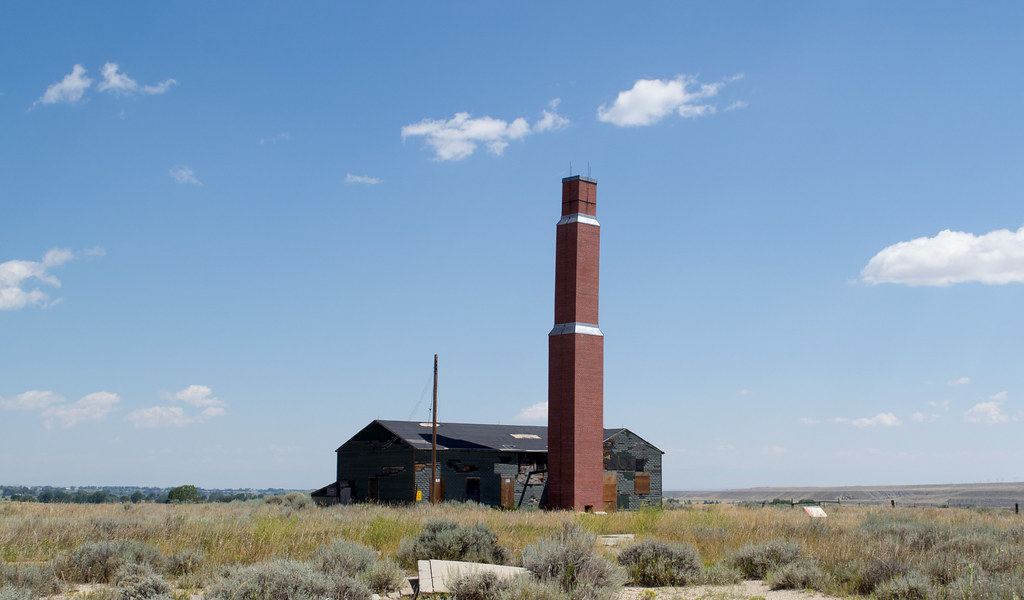


On this episode of Just Housing, “Home Is Where the Heart Is,” Amber Chong, Bella Barnes, and Sophie Kato (joined by Sophie’s grandfather, Ken Kato) discuss how Japanese-American resilience helped the Heart Mountain Relocation Center’s emerge as a unique community, one that functioned as both a prison and a city.
Episode Notes
In 1941, nine-year-old Ken Kato and his family were forcibly relocated from Los Angeles to Pomona, California, where they lived for six months at a horse racing facility before being moved to the Heart Mountain Relocation Center in northern Wyoming.
The Katos’ uprooting and internment was a result of Executive Order 9066, which was signed by Franklin D. Roosevelt on February 19, 1942, two months after the bombing of Pearl Harbor. This gave the War Relocation Authority (WRA) the ability to issue an evacuation order mandating that Japanese Americans close their businesses and sell or store their property in less than two weeks.[1] Many families destroyed other belongings that might be used to further villainize them — items that represented their Japanese heritage, like books, heirlooms, and clothing.[2] The detainees arrived at the camps with few personal objects; they could only bring whatever fit in their suitcases.[3]
“120,000 American citizens and residents of Japanese descent” were relocated and imprisoned.[4] Kato was one of 10,000 placed in the Heart Mountain Relocation Center, hundreds of miles away from many of the detainees’ home cities on the West Coast.[5]
Two Portrayals
An analysis of media coverage of Heart Mountain between 1942 and 1945 shows local newspapers’ seemingly contradictory portrayals of the relocation center.[6] Articles leapt back and forth between depicting Heart Mountain as a lockdown facility where Japanese Americans would no longer pose a threat to the American war effort, and describing it as a luxe metropolis that the U.S. government had altruistically built for Japanese American “refugees.”[7] The prison-paradise dualism that media outlets used to shape the public image of Japanese internment ultimately fanned the flames of racially-charged wartime hysteria while simultaneously broadcasting the benevolent nature of the government’s detainment of Japanese American families.
By writing about Heart Mountain as a city–a region with the population, infrastructure, and public institutions of a U.S. municipality–news sources reduced the process of relocation to a simple move from one city to another and redirected attention from the massive civil rights violation that it represented. Understanding this historical period beyond the narratives generated by U.S. media outlets means bringing in the voices of those who actually resided in the “city” of Heart Mountain.
The Camp as Both a City and a Prison
Oral history accounts like Ken Kato’s help us to see the particular constraints and surveillance that internees experienced, and the ways in which internment in Heart Mountain functioned as a mode of incarceration. The skeleton of a settlement that the WRA had hastily constructed more closely resembled a prison than a neighborhood.[8] However, stories from within the camp show some of the means by which internees personalized their living arrangements, constructed social institutions and gathering spaces, preserved cultural traditions, and formed a resilient community within the confines of the camp, adding valuable nuance to our definitions of “home” and “city.”
Kato shares his memories of his Boy Scout troop at Heart Mountain, as well as the playtime, theatres, gardens, and festival celebrations that made the site feel like home. Yet even as internees cultivated a functional and vibrant municipality for themselves, they continued to cope with the loss of their property, as well as their personal connections to their home cities, cultures, and communities.
The Aftermath
With an abruptness that recalled their initial relocation and imprisonment, the internees were suddenly abandoned after the war, forced to navigate a still-prejudiced world with few resources and assets; “We had to go to Chicago after the war, because my father heard that there was too much prejudice going on in the West Coast. So, my father went there. They were able to get a [place] — it was really in a slum area that he rented a hotel, a room. And they shared it with one of our friends from camp…” Kato recalls.[9]
A postwar survey would later show that 80% of privately stored goods were destroyed, stolen, or sold illegally during the absence of their owners.[10] Kato remembers his parents struggling with this transition:
Well, we lost it all. They lost everything…The real estate person that was supposed to take care of everything, and he said that someone came in and robbed the place and took everything. When my mother came back to Los Angeles, she went to visit him at his house and he thought she was somebody else, and invited her in…the first thing she saw was the Persian rug on his floor and her sewing machine…When she questioned him, he finally realized who she was, and then he delivered that those are the only things that he was able to save for her and that he was just holding that for her.[11]
This realization that most of their belongings were permanently gone, that their lives had been devastatingly paused, and that their supposed home communities and cities had changed drastically in their two-to-three-year imprisonment was another experience of loss for those who were detained in the prison city. However, in the following decades, many Japanese Americans were impressively successful in re-forging a “home” and re-integrating themselves in the socio-spatial landscape.[12]
On these arid lands, the internees then designed an entire city for themselves—for survival, for sustenance, for education, and for cultural preservation. It was not the U.S. government’s benevolence, or a part of its military strategy, that transformed Heart Mountain and other relocation centers, into a real place — a “home,” a tangible, unique, and interconnected city. This city was built by Japanese American resilience.
[1] Saara Kekki, “Life at Heart Mountain: A Dynamic Network Model of a Japanese American Community during World War II,” University of Helsinki, 2019, https://doi.org/https://helda.helsinki.fi/handle/10138/294727.
[2] Saara Kekki, “Life at Heart Mountain.”
[3] Ken Kato (ex-detainee at Heart Mountain) in discussion with the author, November 2020.
[4] Renee Romano, “Perspective | The Trauma of Internment,” The Washington Post (WP Company, April 1, 2019), https://www.washingtonpost.com/news/made-by-history/wp/2018/06/25/the-trauma-of-internment/.
[5] Eric J. Sandeen, “The Japanese American Relocation Center at Heart Mountain and the Construction of the Post-World War II Landscape,” Politics and Cultures of Liberation, 2018, pp. 285-306, https://doi.org/10.1163/9789004292017_015.
[6] Bradford Pearson, “For Japanese-Americans, Housing Injustices Outlived Internment – The New York Times,” accessed December 18, 2020,
[7] Japanese Arrive at New Heart Mountain Town,” Powell Tribune (13 August 1942), 1; “10,000 Japs to be Interned Here,” Cody Enterprise (27 May 1942), 1.
[8] “NATIONAL HISTORIC LANDMARK NOMINATION .” USDI/NPS NRHP Registration Form (Rev. 8-86). United States Department of the Interior, National Park Service , n.d.
[9] Ken Kato, November 2020.
[10] Tom W. Dillard and Michi Weglyn, “Years of Infamy: The Untold Story of America’s Concentration Camps,” The Arkansas Historical Quarterly 37, no. 1 (1978): p. 89, https://doi.org/10.2307/40023168.
[11] Ken Kato, November 2020.
[12] Scott Gen Arai, “Intergenerational Experience of Japanese American Internment: The Grandchildren of the Camps.” Order No. 3598418, John F. Kennedy University, 2012. http://ezproxy.cul.columbia.edu/login?url=https://www-proquest-com.ezproxy.cul.columbia.edu/dissertations-theses/intergenerational-experience-japanese-american/docview/1459228004/se-2?accountid=10226.
Bibliography
Arai, Scott Gen. “Intergenerational Experience of Japanese American Internment: The
Grandchildren of the Camps.” Order No. 3598418, John F. Kennedy University, 2012.
http://ezproxy.cul.columbia.edu/login?url=https://www-proquest-com.ezproxy.cul.columbia.edu/dissertations-theses/intergenerational-experience-japanese-american/docview/1459228004/se-2?accountid=10226.
Dillard, Tom W., and Michi Weglyn. “Years of Infamy: The Untold Story of America’s
Concentration Camps.” The Arkansas Historical Quarterly 37, no. 1 (1978): 89. https://doi.org/10.2307/40023168.
“Japanese Arrive at New Heart Mountain Town,” Powell Tribune (13 August 1942), 1.
Kekki, Saara. “Life at Heart Mountain: A Dynamic Network Model of a Japanese
American Community during World War II.” University of Helsinki, 2019.
https://doi.org/https://helda.helsinki.fi/handle/10138/294727.
Ken Kato, interview by Sophia Kato, November 22, 2020, KenKato2, transcript and
recording.
Romano, Renee. “Perspective | The Trauma of Internment.” The Washington Post. WP
Company, April 1, 2019. https://www.washingtonpost.com/news/made-by-history/wp/2018/06/25/the-trauma-of-internment/.
Sandeen, Eric J. “The Japanese American Relocation Center at Heart Mountain and the
Construction of the Post-World War II Landscape.” In Politics and Cultures of Liberation: Media, Memory, and Projections of Democracy, edited by Bak Hans, Mehring Frank, and Roza Mathilde, 285-306. LEIDEN; BOSTON: Brill, 2018. Accessed December 20, 2020. http://www.jstor.org/stable/10.1163/j.ctvbqs8h0.17.
“10,000 Japs to be Interned Here,” Cody Enterprise (27 May 1942), 1.
Featured Image: Heart Mountain Interpretive (Relocation) Center WY hospital, Photo Credit: Don Barrett via Flikr CC-BY-NC-ND 2.0
