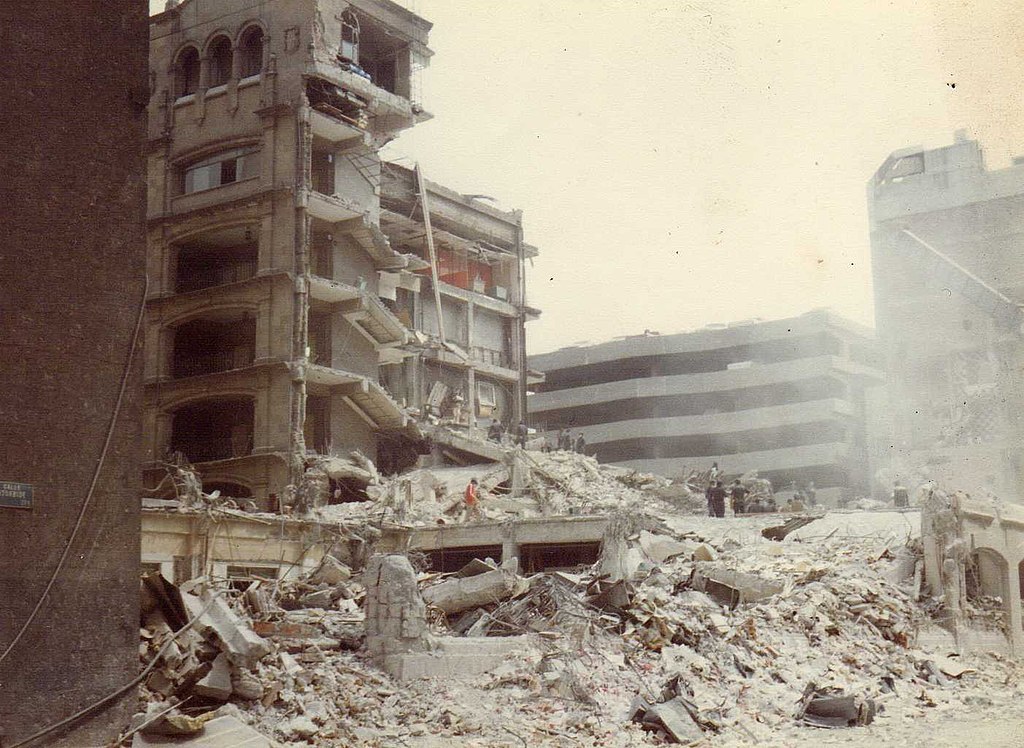


Imagine this: it’s a cool, fall morning in September. You’re just waking up, when your bed begins to rumble (Poniatowska, 2010). On September 19, 1985, that’s exactly how many residents of Mexico City awoke, after an earthquake of magnitude 8.1 shook the coast (Diane, 2006, p. 203). Roughly 24 hours later, another major earthquake struck the city.
Together, these consecutive disasters destroyed thousands of buildings and took tens of thousands of lives.
Devastation spanned the Mexican capital, but the heart of the city took the hardest blow. The city center is home to everything from dense residential neighborhoods to government buildings. Hundreds of thousands of residents were left without necessary city services, work, or housing, which is the focus of this podcast. Without a unified or supportive response from the government, residents and earthquake victims took matters into their own hands and became the voices behind an incredible housing movement. This particular movement was built on decades of organizing in the same neighborhoods as those most affected by the disaster in 1985.
Hundreds of community-led emergency housing and shelter units sprung up around the city, but many residents chose to stake a claim to the streets. This was just one of the many ways residents fought for their cause. In the week following the earthquake, a massive protest emerged, placing the victims’ demands in full view. These demands included the expropriation of vecindades, a local sort of tenement housing for the poor, and permanent residence in the district. The incredible fuel and solidarity behind the march received much public attention and forced government officials to respond.
From the housing movement emerged a successful housing agency called the Renovación Habitacional Popular program. In just two years, this program was able to construct and restore over 48,000 housing units! The program also produced a special initiative that absorbed community members into the government’s planning and action process.
These efforts affirmed the rights of earthquake victims and city residents, and the movement was ultimately successful in forcing the government to meet its demands.
Tune in to hear Luis Fernando Tolentino, the curator of a recent exhibit in Mexico City called The Right to the City. He gave us a tour of the exhibit, and told us what the “right to the city” means in Mexico. His work sheds light on the impact of the housing movement and similar movements over the last century in Mexico City.
Below, find a comprehensive collection of our sources.
Alpern, D., Ellis, J., Levinson, W., & Schrager, M. (1985, September 22). [Audio file].
Newsweek On Air 09/22/1985. Retrieved from
Ardekani, S. A., & Hobeika, A. G. (1988). Logistics problems in the aftermath of the 1985
Mexico City earthquake. Transportation Quarterly, 42(1).
Comerio, M. C. (1998). Disaster hits home: New policy for urban housing recovery. Univ of
California Press.
Comerio, M. C. (1997). Housing issues after disasters. Journal of Contingencies and Crisis
Management, 5(3), 166-178.
Davis, D. E. (2015). Reverberations: Mexico City’s 1985 Earthquake and the Transformation of the Capital. In F. Miraftab & N. Kudva (Eds.), Cities of the global south reader. essay, Routledge.
Dynes, R. R., Quarantelli, E. L., & Wenger, D. (1990). Individual and organizational response to
the 1985 earthquake in Mexico City, Mexico. Disaster Research Center.
Geis, D. E., & Smith, K. N. Architectural and Urban Design Lessons from the 1985 Mexico City
Earthquake: The Mexican Perspective.
Inam, A. (1999). Institutions, routines, and crises: post-earthquake housing recovery in Mexico
City and Los Angeles. Cities, 16(6), 391-407.
Reminiscences of Gabriel Sama. (2003). courtesy of Oral History Archives at Columbia
University, Rare Book & Manuscript Library.
López Luján, L., & Levin, J. (2005). Tenochtitlán. Oxford University Press, USA.
Nadelman, R., Nichols, C., Rowbottom, S., & Cooper, S. (2019). Learning from the Mexico City
Earthquake: Dynamics of Vulnerability and Preparedness The Case of Housing.
Novelo-Casanova, D. A., Antonio-Nakamura, Y. A., Valdés-Pérez, V., & Pineda-Loperena, G.
(2012). Measuring social vulnerability from risk perception case study: the
Nonoalco-Tlatelolco housing complex damaged during the Mexican 1985 major
earthquake. Humanit. Soc. Sci. Rev., 1(4), 253-262.
Poniatowska, E. (2010). Nothing, Nobody: The Voices of the Mexico City Earthquake. Temple
University Press.
Tavera-Fenollosa, L. (1998). Social movements and civil society: The Mexico City 1985
earthquake victim movement. Yale University.
Various Publishers. (1985). Earthquake in Mexico 1985: Popular Sector Documents. From
Princeton University Library.
Featured Image Credit: Roberto Esquivel Sánchez: Images of Mexico City Earthquake, September 19, 1985. CC-BY 4.0 Images donated by Roberto Esquivel Sánchez family.
