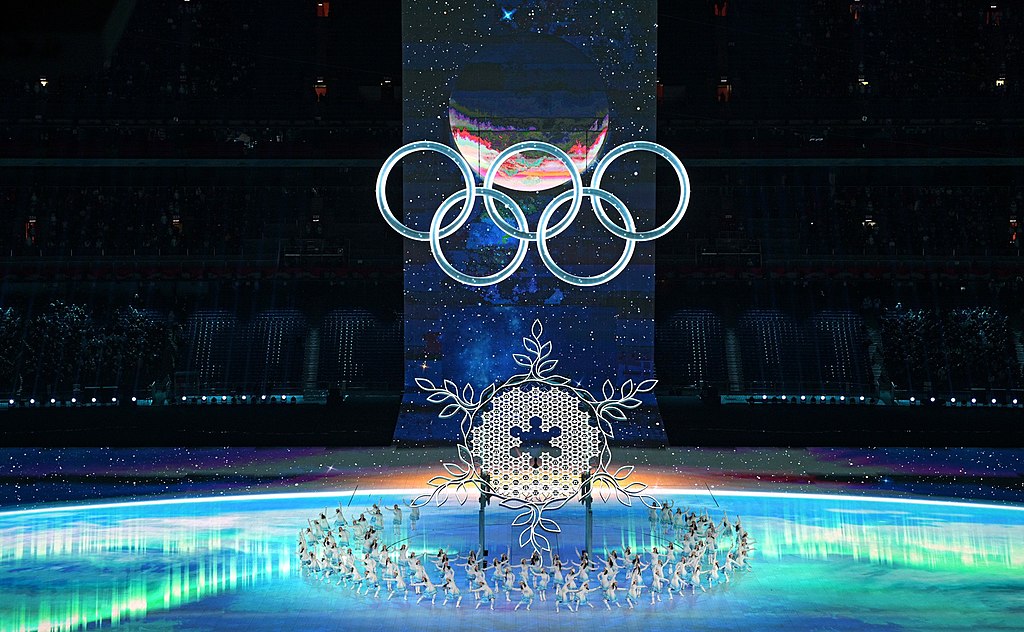


Earlier this year, many of us watched as athletes from across the globe ice danced, ski jumped and snowboarded across three Beijing venues at the 2022 Winter Olympics. China’s paramount leader, Xi Jinping used the 2022 Olympics to project a message of Chinese strength and unity[1]. This was not the first time that the Chinese government had chosen the Olympics to make a statement. “New Beijing. Great Olympics” was the slogan for the 2008 Beijing Summer Olympics, a spectacle that launched China on the world stage. The city of Beijing constructed new highways, subways and an airport terminal in anticipation of the launch of the games. The Bird’s Nest and the Water Cube became iconic buildings that symbolized the “new Beijing,” a departure from the city that had made an unsuccessful Olympic bid in 1993, a short four years after the 1989 Tiananmen Square Protests had become front page news. In 2000 however, Beijing’s successful bid for the 2008 Olympic Games sent a message. China was ready to compete with the West economically, politically and culturally; urban infrastructure development and iconic venues were to be just the start of what the nation set out to achieve. As an article from the Washington Post stated, ‘China [was] a country headed toward the next century.’[2] And that may have been true, but whilst the Chinese Olympic Committee prepared the city for visitors, it neglected to meet the needs of the local residents, the population that called Beijing home well before the athletes, the trainers and the tourists moved in. The Beijing municipality carried out a number of “environmental improvement projects,” several of which are still touted on the International Olympic Committee website as part of Beijing’s legacy. Yet a report by the Centre on Housing Rights and Eviction (COHRE) indicates that between 2000 and 2008, roughly 1.5 million Beijing residents were displaced in the name of these Olympic “improvement projects,” a number that COHRE speculates likely only includes the permanent local residents that were eligible for compensation and not the low income migrants tenants that occupied the informal and low quality settlements and whose numbers far outweighed that of the permanent resident population.[3]
So how successful were these Olympic Improvement Projects for the ordinary dwellers of Beijing? In this episode of Just Housing, we get into the weeds of exactly how the 2008 Olympic Games affected, displaced and compromised the rights of those already living in the city and question what was the real cost of the 2008 Beijing Olympics.
Bibliography
Boykoff, Jules. NOlympians: Inside the Fight Against Capitalist Mega-Sports in Los Angeles, Tokyo and Beyond. Fernwood Publishing, 2020.
Delaplace, Marie, and Pierre-Olaf Schut. Hosting the Olympic Games: Uncertainty, Debates, and Controversy. Advances in Tourism Ser. Abingdon, Oxon ; New York, NY: Routledge, Taylor & Francis Group, 2019. https://doi.org/10.4324/9780429274695.
deLisle, Jacques. ‘Beijing’s Olympic Moments, 2008 and 2022: How China and the Meaning of the Games Have, and Have Not, Changed – Foreign Policy Research Institute’. Foreign Policy Research Institute, 3 February 2022. https://www.fpri.org/article/2022/02/beijings-olympic-moments-2008-and-2022-how-china-and-the-meaning-of-the-games-have-and-have-not-changed/.
Flyvbjerg, Bent, et al. “Regression to the Tail: Why the Olympics Blow Up.” Environment and Planning A: Economy and Space, vol. 53, no. 2, Mar. 2021, pp. 233–260, doi:10.1177/0308518X20958724.
Hooghe, Ingrid d’. China’s Public Diplomacy. Martinus Nijhoff Publishers, 2014
Kolatch, Jonathan. ‘Beijing Deserves the 2000 Olympics’. Washington Post, 30 July 1993. https://www.washingtonpost.com/archive/opinions/1993/07/30/beijing-deserves-the-2000-olympics/3e118bed-4b5b-43bc-a775-efaaa332dd9e/.
Li, Lillian M., Alison J. Dray-Novey, and Haili Kong. Beijing: From Imperial Capital to Olympic City. 1st ed. New York: Palgrave Macmillan, 2007.
Mangan, J. A., and Jinxia Dong, eds. Beijing 2008: Preparing for Glory: Chinese Challenge in the ‘Chinese Century’. Sport in the Global Society. London: Routledge, 2009.
Rithmire, Meg. “Land Politics and Local State Capacities: The Political Economy of Urban Change in China.” The China Quarterly, vol. 216, 2013, pp. 872–895., doi:10.1017/S0305741013001033.
Shin, Hyun Bang, and Bingqin Li. “Whose Games? The Costs of Being ‘Olympic Citizens’ in Beijing.” Environment and Urbanization, vol. 25, no. 2, Oct. 2013, pp. 559–576, doi:10.1177/0956247813501139.
Smith, Saphora, and Jennifer Jett. ‘China Is the Olympics Host Again — but 2022 Showcases a Very Different Country than 2008’. NBC News, 3 February 2022. https://www.nbcnews.com/news/world/beijing-winter-olympics-china-changed-2008-2022-rcna12047.
Zimbalist, Andrew S., Jules Boykoff, Juliana Barbassa, Theresa Williamson, Renata Latuf de Oliveira Sanchez, Stephen Essex, and Jamil Chade, eds. Rio 2016: Olympic Myths, Hard Realities. Washington, D.C: Brookings Institution Press, 2017.
Xu, Chunxiao. ‘Beijing 2008 Olympic Games and Urban Land Use Evolution: Did the 2008 Olympics Benefit Local Communities?’ Columbia University, 2015. https://doi.org/10.7916/D8XG9QBT.
Li, Xiang (Robert), and Kyriaki (Kiki) Kaplanidou. “The Impact of the 2008 Beijing Olympic Games on China’s Destination Brand: A U.S.-Based Examination.” Journal of Hospitality & Tourism Research, vol. 37, no. 2, May 2013, pp. 237–261, doi:10.1177/1096348011425499.
Wickenden, Dorothy. ‘What the Beijing Olympics Reveal About China’. Politics and More. The New Yorker. 10 February 2022.
[1] Wickenden, Dorothy. ‘What the Beijing Olympics Reveal About China’. Politics and More. The New Yorker. 10 February 2022.
[2] Kolatch, Jonathan. ‘Beijing Deserves the 2000 Olympics’. Washington Post, 30 July 1993.
[3] Shin, Hyun Bang, and Bingqin Li. “Whose Games? The Costs of Being ‘Olympic Citizens’ in Beijing.” Environment and Urbanization, vol. 25, no. 2, Oct. 2013, pp. 559–576.
Featured Image credit: www.kremlin.ru; licensed under the Creative Commons Attribution 4.0 International license.
