

This episode examines the ways in which imperialism impacted perceptions of urban poverty and housing in late 19th-century London, England and Cairo, Egypt. We analyze the British government’s responses to emerging urban crises in each city, and how social perceptions of the poor shaped these policy response. This podcast addresses questions like: How did these perceptions shift between the metropole, London, and the colony, Cairo? And, how does a difference in perception result in differences in policy? To answer these questions, we pored over primary accounts of reformers and travel journal logs from the 19th century. Through our research and expert interviews, “Cairo to London: Imperial Dynamics of Housing the Poor” ultimately seeks to understand the consequences of these differences in perceptions of the poor in the context of urban housing.
We first examine the changing perception of the poor in London through the eyes of the social reformer Charles Booth. Booth was responding to a crisis of urban housing spurred largely by rural to urban migration, which put pressure on London’s existing housing infrastructure. This led to significant overcrowding in poor neighborhoods and concentrations of precarious housing, referred to as “slums,” throughout the city. In an 1889 account, Booth reflected that in the East End of London “in little rooms no more than 8ft. square, would be found living father, mother, and several children” and “drunkenness and dirt and language prevailed, and violence was common.”1 Booth’s observations represent a shift in how the British public viewed poverty, as well as how the government moved to “contain” poverty and remove it from sight. Booth’s contemporaries saw a hierarchy of humanity, and described the poor using language that reflected Britain’s imperial identity.2,3
With this understanding of how imperial dynamics influenced perceptions of the poor in London, we turn to Cario, Egypt, which the British occupied in 1882, to explore how these perceptions were replicated and pushed to greater extremes. We begin this discussion by highlighting how 19th-century Cairo was clearly divided along imperial lines, which separated the city into an Egyptian Cairo and a British Cairo. These dual cities differed in more than just population; British Cairo boasted that their city was the height of modernization, while Egyptian Cairo seemed to have been left in the past. Central to our discussion is an understanding of the British perceptions of the poor in their colony. Travel journals from the mid-1800s suggest that the British viewed Egyptians as dirty and immoral; this perception thus informed how the British placed Egypt under its tutelage. The hawari–the winding and narrow alleyways–of Cairo were the organizational units that had determined the city’s structure since the medieval period.4 The 19th to early 20th centuries, however, saw the transformation of the hawari into urban marginal communities as part of the government’s efforts to modernize Cairo. Like London, Cairo experienced an immense wave of rural to urban migration that left the hawari overcrowded with workers. Wealthy merchants and European colonizers left, leading to the creation of the divided colonial city. The hawari acted as sites of resistance, however, even as they were designated slums by the British.
This episode of Just Housing explores how the British viewed poverty in the metropole (London) and the colony (Cairo) and highlights how these perceptions informed policy decisions regarding housing. It leaves us pondering how people’s experiences of urban poverty and their struggles for housing justice might have shaped the multitudes of untold individual stories in both cities.
1 Booth, Charles. Life and Labor of the People in London. New York, NY: Macmillan, 1903.
2 Valenze, Deborah. Interview. Virtual. 2020
3 Pederson, Susan. Interview. Virtual. 2020
4 Abdelmonem, M. Gamal. The Architecture of Home in Cairo. London: Routledge, 2016.
Bibliography
Abdelmonem, M. Gamal. The Architecture of Home in Cairo. London: Routledge, 2016.
Abu-Lughod, Janet L. Cairo: 1001 years of the city victorious. Princeton, NJ: Princeton
University Press, 1971. https://www-fulcrum-org.ezproxy.cul.columbia.edu/epubs/m613mx79d?locale=en
Aftab, Iza. “The Spatial Form of Bangladeshi Community in London’s East End.” London:
University College London. Accessed December 21, 2020. http://spacesyntax.tudelft.nl/media/prcdngsabstracts/izaaftab.pdf.
AlSayyad, Nezar. Cairo. Cambridge, MA: Belknap Press of Harvard University Press, 2011. https://web-a-ebscohost-com.ezproxy.cul.columbia.edu/ehost/detail/detail?vid=0&sid=a117203a-764a-49ed-a225-530ff3f5f84a%40sessionmgr4007&bdata=JnNpdGU9ZWhvc3QtbGl2ZSZzY29wZT1zaXRl#AN=390179&db=e025xna.
Booth, Charles. Life and Labor of the People in London. New York, NY: Macmillan, 1903.
Burnett, John. A Social History of Housing 1815-1970. London: David and Charles Inc., 1978.
Egypt – Traffic with continuous hooters (Old Town Cairo). BBC, n.d. https://sound-effects.bbcrewind.co.uk/search?q=Egypt%20-%20Traffic%20with%20continuous%20hooters%20(Old%20Town%20Cairo).
Egypt – Market in Cairo’s Old Town (no traffic). BBC, n.d. https://sound-effects.bbcrewind.co.uk/search?q=Egypt%20-%20Market%20in%20Cairo%27s%20Old%20Town%20(no%20traffic).
Gore, Montague. On the Dwellings of the Poor and the Means of Improving Them. London:
James Rideway, Piccadilly. 1851. https://hdl.handle.net/2027/chi.095286243
Hollingshead, John. “Our London Model Lodging Houses.” In Ragged London in 1861. 1861.
Mitchell, Timothy. Colonising Egypt:. Berkeley, CA: University of California Press, 1988. https://web-a-ebscohost-com.ezproxy.cul.columbia.edu/ehost/ebookviewer/ebook/bmxlYmtfXzIxMjk4X19BTg2?sid=d1599b68-a3d1-4d62-b790-1f55f723b5e5@sessionmgr4008&vid=0&format=EB&rid=1.
Pederson, Susan. Interview. Virtual. December 2020
Pollard, Lisa. Nurturing the Nation: The Family Politics of Modernizing, Colonizing and Liberating Egypt (1805-1923). Berkeley: University of California Press, 2005.
Restaurants & Kitchens – Noisy French restaurant, London. BBC, n.d. https://sound-effects.bbcrewind.co.uk/search?q=london
Reverie (Piano Version) Ft. Adarsh PV. By Lahar. 2020. https://soundcloud.com/musicbylahar.
Ross, Ellen. “”Fierce Questions and Taunts”: Married Life in Working-Class London, 1870-1914.” Feminist Studies 8, no. 3 (1982): 575-602. Accessed December 21, 2020. doi:10.2307/3177713.
Selim, Geham. Unfinished Places: The Politics of (Re)making Cairo’s Old Quarters. London, UK: Routledge, 2016. Accessed November 10, 2020. https://www-taylorfrancis-com.ezproxy.cul.columbia.edu/books/9781315716190.
Singerman, Diane. Cairo Contested: Governance, Urban Space, and Global Modernity. New York, NY: American University in Cairo Press, 2009. Accessed November 10, 2020. https://cairo-universitypressscholarship-com.ezproxy.cul.columbia.edu/view/10.5743/cairo/9789774162886.001.0001/upso-9789774162886.
Stedman-Jones, Gareth. Outcast London: A Study in the Relationship of Classes in Victorian
Society. London: Oxford University Press, 1971.
“Tower Hamlets: Poverty and Inequality Data for Tower Hamlets.” Trust For London: Tracking
Poverty and Inequality. Trust for London, October 9, 2020. Accessed 12/21/2020. https://www.trustforlondon.org.uk/data/boroughs/tower-hamlets-poverty-and-inequality-indicators/.
Valenze, Deborah. Interview. Virtual. 2020
Wohl, Anthony. The Eternal Slum: Housing and Social Policy in Victorian London (1st ed.).
New York: Routledge, 1977. https://doi-org.ezproxy.cul.columbia.edu/10.4324/9781351304047
Yelling, J.A. Slums and Slum Clearance in Victorian London. London: Routledge, 1986.
Sound Attributions
Reverie (Piano Version) ft. Adarsh PV by Lahar https://soundcloud.com/musicbylahar
Creative Commons — Attribution 3.0 Unported — CC BY 3.0
Free Download / Stream: https://bit.ly/al-reverie
Music promoted by Audio Library https://youtu.be/77EPJ_BcT98
Egypt – Traffic with continuous hooters (Old Town Cairo).
Egypt – Market in Cairo’s Old Town (no traffic).
Restaurants & Kitchens – Noisy French restaurant, London.
bbc.co.uk – © copyright [2020] BBC
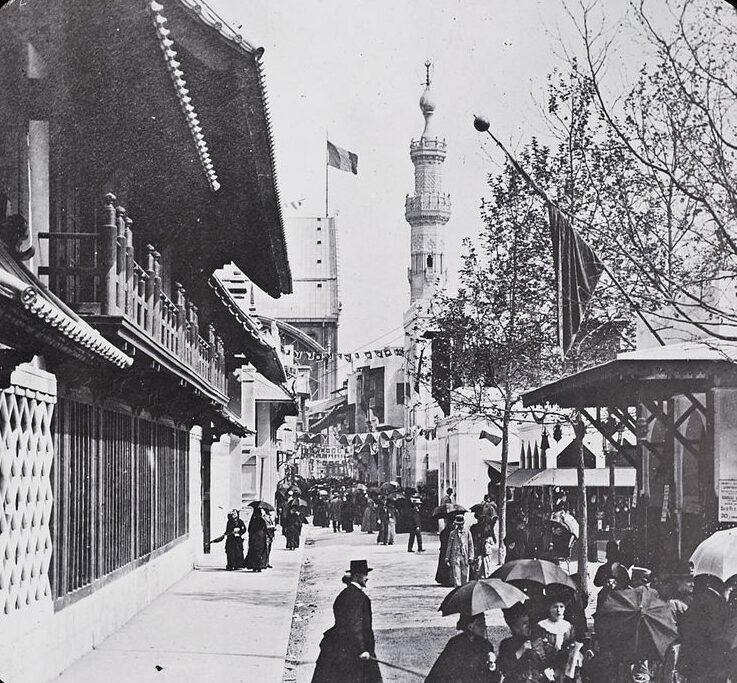
Featured Image: Rue du Caire, Paris Exposition, 1889 (street in Cairo), From the Henry Clay Cochrane Collection (COLL/1) at the Marine Corps Archives and Special Collections, CC-BY 2.0
