

Sofia Partida, Heli Sun, and Brooke McCormick
Today on Just Housing, we’ll be exploring issues of design, gender, and cultural expression through the lens of state-provided apartment housing in the Soviet Union during the second half of the twentieth century. To give a quick primer, this period was characterized by the transition of people living in communal units and agricultural villages to individual families living in four-to-five story urban walk-ups nicknamed khrushchyovka, named for Soviet Primier Nikita Khrushchev, which the government rapidly constructed to meet a nationwide dearth of housing following World War Two. This housing typology became ubiquitous across the Soviet Union for its standardized floor plan. Many still stand, outlasting their projected longevity for habitation to the detriment of current residents.
At the outset of this podcast, our group was preoccupied with the following analytical questions: how should governments provide housing for their citizens? What’s the connection between design and culture in state-sponsored housing? By studying the khrushchyovka units, we have come up with a preliminary response to this question. Despite living under an authoritarian government, citizens made state-provided housing their own, proving that state-provided housing does not mean living in entirely impersonal spaces. With a million private housing units built in just four years between 1956 and 1959 and rapid urbanization, there was finally “room for a personal life” for USSR citizens in the words of our interviewee, Dr. Brandon Schechter, a Soviet history expert. Schechter provides us with powerful insight into this housing and cultural transition, which we supplement with a narrative about the rapid economic transformation of the country also at play here.
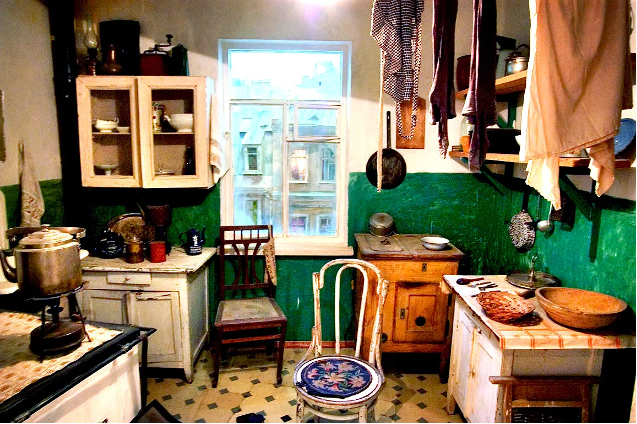
We trace how the kitchen emerged as a salient design feature of these apartments. Utilitarian and simple, these spaces contained just essential features like running water, a gas stove, and overhead cabinets and counters fitted for the height of the average Soviet woman. Such apartment units would have appeared strikingly modern compared to the communal housing of the past, which we noted with interest, was more in line with Communist ideology.
This episode also delves into how the state straddled two seemingly contradictory domestic arrangements: on the one hand, advocating for the nuclear family with a housewife performing domestic labor; on the other, the modern Communist household where women would work outside the home. In conjunction with academic sources, we also consult a 1969 novella written by Soviet writer Natalya Baranskaia called “A Week Like Any Other Week” to reveal truths about domesticity in this era. We leave it to future researchers to find an interview with a resident of a khrushchyovka to complement Baranskaia’s illuminating account.
Music and scholarly material are inextricably linked in this podcast. Songs from that era shed light on how people used this state-subsidized housing for political resistance and consumption of illicit Western media. Through analyzing lyrics, this episode concludes that private kitchens unintentionally became valued places to protest the government and relax with friends and family members. In the same vein, we found compelling references in a book by an American historian writing in the 1960s to a common but clandestine practice in which residents in these Soviet apartment units traded them through informal outdoor markets, allowing people to assert autonomy over and leverage the value of where they lived, despite a formal lack of private ownership.
With this brief history of khrushchyovka housing in the Soviet Union, we’ve come to appreciate the extent to which housing provision and design can radically alter gender, culture, and everyday life. It’s difficult to judge whether this housing experiment was successful; like most major societal housing projects, there were positive and negative outcomes at once. We’ll let you decide for yourself. As this episode was produced in Spring 2022 during Russia’s invasion of Ukraine, we also sincerely hope this story will add texture and empathy to your understanding of the region.
Episode Sources
Attwood, Lynne. Gender and Housing in Soviet Russia: Private Life in a Public Space. Manchester University Press, 2010.Baranskaia, Natalia. A Week like Any Other: Novellas and Stories. Seal Press, 1990.
Chatterjee, Choi. “Everyday Life in Russia Past and Present.” The American Historical Review 120, no. 5 (2015). https://doi.org/10.1093/ahr/120.5.2018d.
“Cheryomushki (1962) by Herbert Rappaport.” Kino Klassika Foundation, May 8, 2020.
Fields, Deborah. “Everyday Life and the Problem of Conceptualizing Public and Private during the Khrushchev Era.” Indian University Press, 2015. https://www.jstor.org/stable/j.ctt16gz8t5.
“How Soviet Kitchens Became Hotbeds of Dissent and Culture.” NPR. Morning Edition, May 27, 2014.
“The Kitchen Debate.” New York Historical Society
Malaia, Kateryna. A Unit of Homemaking: The Prefabricated Panel and Domestic Architecture in the Late Soviet Union. Architectural Histories, 8(1), p.12, 2020.
Manaev, Georgy. “The Most Important Room in the Soviet Apartment.” Russia Beyond, January 26, 2021.
Mikhaylyuk, Vitaly. “The Condemned: Living in a Khrushchyovka.” Russia Beyond, 2017. https://www.rbth.com/longreads/khrushchyovki/.
Morton, Henry. The Contemporary Soviet City (1st ed.). Routledge, 1984.
Reid , Susan E. “Everyday Aesthetics in the Khrushchev-Era Standard Apartment.” Etnofoor, August 10, 2019. https://core.ac.uk/download/pdf/42483549.pdf.
Reid, Susan E. “The Khrushchev Kitchen: Domesticating the Scientific-Technological Revolution.” Journal of Contemporary History 40, no. 2 (2005): 289–316. http://www.jstor.org/stable/30036325.
Varga-Harris, Christine. Stories of House and Home: Soviet Apartment Life during the Khrushchev Years. Cornell University Press, 2015.
Zubovich, Katherine. “Urban Renewal and Displacement in Soviet (and Post-Soviet) Moscow.” Global Urban History, September 28, 2017.
